
Do I Have a Case After a Car Accident in Washington?
Yes – possibly. If you were injured in a Washington car accident that was caused by someone else’s negligence, you may be entitled to compensation for medical expenses, lost income, pain and suffering, and other damages. Dolman Law Group represents accident victims throughout Washington and offers free consultations.
Washington Car Accident Quick Facts
- Free Consultation: Discuss your case with a Washington car accident lawyer at no cost.
- No Fees Unless We Win: You pay nothing unless we recover compensation for you.
- Statute of Limitations: Most Washington car accident lawsuits must be filed within three years of the crash.
- Comparative Negligence: You may still recover compensation even if you were partially at fault for the accident.
- Compensation May Include: Medical expenses, lost wages, property damage, pain and suffering, and future losses.
- Cases We Handle: Car accidents, rideshare accidents, commercial vehicle crashes, multi-vehicle collisions, and uninsured or underinsured motorist claims.
- Serving All of Washington: Representing injured clients throughout Seattle, Spokane, Tacoma, Bellevue, Everett, Vancouver, Yakima, and communities across the state
After a car accident, most people expect to get medical bills. What catches them off guard is the lost income, insurance disputes, and the uncertainty of what to do next. Washington state makes it possible for you to recover compensation after a car accident caused by another driver’s negligence. At Dolman Law Group, we do the hard work of investigating, gathering evidence, and negotiating with the insurance company.
Evidence becomes harder to get as each day passes. The longer you wait to act, the higher your risk is of not being able to get critical evidence like witness statements and dashcam or surveillance footage. We can help, and it costs you nothing to talk to one of our award-winning trial attorneys.
What Should You Do After a Car Accident in Washington?
If you were involved in a car accident, your priority should be getting medical care and documenting what happened. Once your injuries have been stabilized, and the immediate situation is under control, there are a few steps that can make your life much easier when you file an insurance claim or lawsuit.
Follow Through With Your Medical Treatment
Get evaluated after the accident and follow the treatment recommended by your medical providers. Some car accident injuries become more noticeable over the hours or days after a crash, and recovery does not always follow a straight line.
Keep your follow-up appointments, attend physical therapy when prescribed, and tell your providers about new or changing symptoms. This creates a medical record showing how your injuries developed and how they affected your recovery.

Keep Your Accident Documents in One Place
Car accident claims generate a surprising amount of paperwork. Create a physical folder, digital folder, or both and keep everything related to the accident together.
This may include:
- Police reports and accident information
- Photos and videos from the crash
- Medical records, bills, and insurance statements
- Prescription and out-of-pocket expense receipts
- Repair estimates and vehicle damage records
- Pay stubs or other documentation of missed work
- Letters, emails, and other insurance correspondence
- Witness names and contact information
You may not know which documents will ultimately matter. Keeping them organized from the beginning is much easier than trying to reconstruct everything months later.
Keep a Simple Record of Important Calls and Conversations
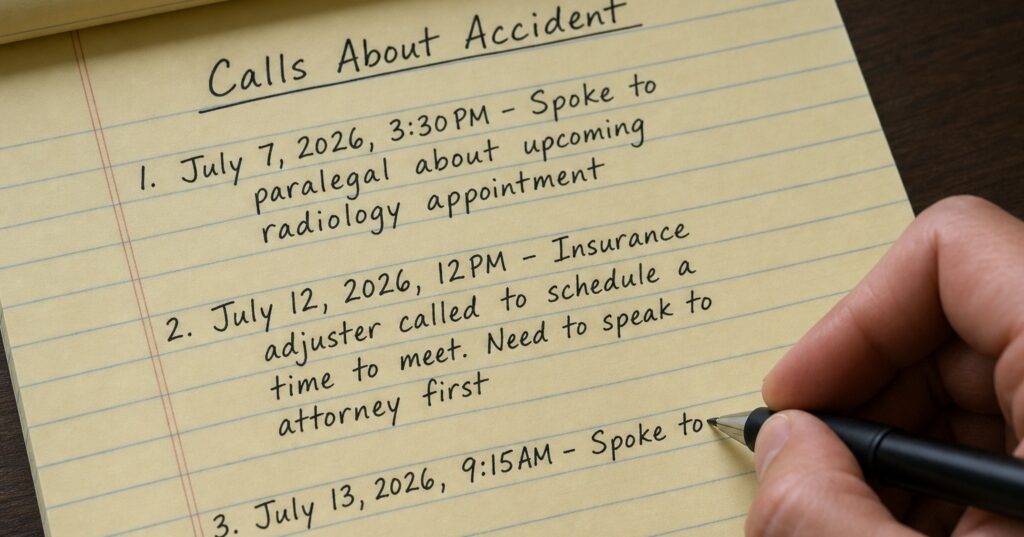
You will probably speak with insurance adjusters, medical providers, repair shops, attorneys, and other people while your claim is pending. Keep a simple log showing the date and time of important calls, who you spoke with, and a short description of what was discussed.
You do not need to write a novel after every phone call. A few sentences can be enough to help you remember who said what if a question comes up later.
Consider Keeping a Recovery Journal
Medical records document diagnoses and treatment, but they do not always capture what an injury is actually doing to your daily life.
A simple recovery journal can help you keep track of pain, symptoms, physical limitations, missed activities, sleep problems, and changes in your ability to work or handle ordinary responsibilities. You do not have to write in it every day. The goal is simply to create an accurate record while the details are still fresh.
Preserve Evidence You Already Have
Save photographs, videos, witness information, damaged-property records, dashcam footage, and other evidence in your possession. Do not assume you will always be able to find it later.
A car accident attorney can investigate the crash and obtain evidence you cannot reasonably collect yourself. The materials you preserve, however, can provide an important starting point for that investigation.
Common Issues That Complicate Washington Car Accident Claims
After a crash, many people expect the facts to speak for themselves. If another driver caused the accident, getting compensated should be fairly straightforward, right? In practice, that’s not always how things work.
Injuries May Not Appear Right Away
Sometimes, victims of an accident may walk away from a crash feeling fine, only to develop pain and other symptoms days or weeks later. Some common examples include neck injuries, back injuries, and concussions. When there’s a delay between the crash and treatment, insurance companies may try to use it against the injured person.
Fault Isn’t Always Black and White
Washington follows a comparative negligence system. That means more than one person can share responsibility for a crash. Even when the other driver was clearly negligent, an insurer may argue that you were partly to blame in an effort to reduce what it pays.
Evidence Can Make or Break a Claim
A police report is important, but it may only tell part of the story. Today, accident claims can involve dashcam footage, surveillance video, vehicle data, witness statements, and even cellphone records. The sooner evidence is preserved, the better.
Insurance Companies Don’t Pay Without Reviewing and Challenging Your Case
Insurance adjusters review claims daily, and it’s not uncommon for them to challenge injuries, argue over medical treatment, or disagree on the worth of a case. What may look like a straightforward claim can rapidly turn into a disagreement.
For these reasons, even a seemingly straightforward car accident can involve legal and factual issues that aren’t immediately apparent. Knowing the potential challenges ahead can help you make informed decisions about your claim.
Washington Car Accident Statistics and Trends
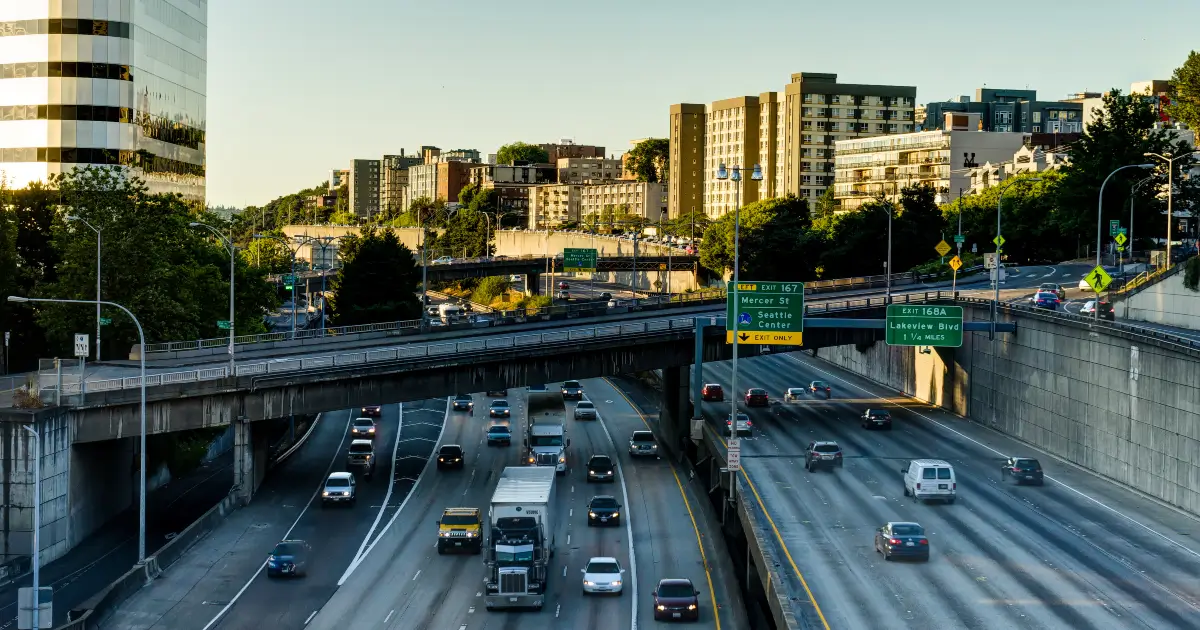
Every year, thousands of people find themselves dealing with the aftermath of car accidents across Washington. Some crashes result in little more than scratched paint, while others leave victims facing serious injuries, long recoveries, and unexpected financial strain.
Recent data from the Washington Traffic Safety Commission shows that 731 people died in traffic crashes across the state in 2024. While that number marked an improvement from the previous year, it remains well above the levels Washington reported before the pandemic.
The causes of these crashes are familiar: speeding, distracted driving, impaired driving, and other risky behaviors. Data collected through the Washington State Department of Transportation’s Crash Data Portal don’t just happen on busy highways. They also happen in familiar areas, and on local streets and rural highways.
Numbers provide useful context, but they don’t tell us where roadway risks are concentrated or why certain driving environments may be more dangerous than others. The map below gives us more insight about these risks, highlighting major driving corridors and local transportation conditions in 10 Washington cities.
High-Risk Driving Corridors Across Washington State
Traffic collisions happen throughout Washington, but fatal and serious-injury crashes are not distributed evenly across the state. Many occur along heavily traveled interstates, wide urban arterials, freight routes, and streets that combine higher vehicle speeds with frequent intersections, driveways, transit stops, and pedestrian crossings.
The interactive map below highlights major driving corridors in Seattle, Spokane, Tacoma, Bellevue, Vancouver, Everett, Kent, Renton, Yakima, and Federal Way. Select a city to explore the roadways and local transportation conditions that may increase the risk of a serious collision.
How We Selected These Corridors: The locations shown are based on publicly available crash data, municipal High Injury Networks, Vision Zero plans, corridor safety studies, and Washington transportation reports. The map is intended to illustrate documented transportation risks. It does not identify every dangerous road or predict where a crash will occur.
Explore High-Risk Driving Corridors by City
Primary Corridors: Aurora Avenue N (SR 99), Rainier Avenue S, 4th Avenue S, and Interstate 5
Primary Concerns: Fatal and serious-injury crashes, pedestrian exposure, high-speed arterial traffic, turning conflicts, freeway congestion, and frequent transit activity
Seattle has formally identified a High Injury Network consisting of streets with a history of fatal and serious-injury crashes. Several wide, multilane arterials appear prominently within that network.
Aurora Avenue N is one of the city’s busiest streets and a major transit and freight route. The Seattle Department of Transportation has also identified it as a top safety priority because of its history of fatal and serious-injury crashes, particularly those involving pedestrians. Rainier Avenue S and 4th Avenue S are likewise among the arterial streets Seattle has targeted through its Vision Zero safety program.
Interstate 5 adds a different set of risks as it carries heavy commuter, commercial, and regional traffic directly through the center of the city. Sudden congestion, merging vehicles, lane changes, and limited reaction time can all contribute to serious freeway collisions.
Primary Corridors: Division Street, Sprague Avenue, and Interstate 90
Primary Concerns: High-volume arterial intersections, turning conflicts, pedestrian exposure, interstate freight traffic, and seasonal snow and ice
Spokane’s major routes connect local neighborhoods with downtown businesses, regional highways, and Eastern Washington freight traffic. Division Street and Sprague Avenue are particularly important urban arterials with frequent intersections, commercial access points, and substantial vehicle activity.
City planning materials have identified collision and congestion concerns near the intersection of Division Street and Sprague Avenue, including the nearby I-90 ramps. Spokane’s broader Vision Zero planning also evaluates the roadway characteristics associated with fatal and serious-injury crashes across the city.
Interstate 90 carries passenger vehicles and commercial freight across Spokane and the rest of Eastern Washington. During the winter, snow, ice, reduced visibility, and drivers traveling too fast for conditions can add to the ordinary risks associated with an interstate corridor.
Primary Corridors: Portland Avenue E, Pacific Avenue, Interstate 5, and the SR 16 connection
Primary Concerns: High-risk arterial travel, pedestrian and bicycle exposure, interstate congestion, port-related freight movement, and complicated merging patterns
Tacoma’s road network carries local commuters, regional travelers, and freight moving through the Port of Tacoma and the broader South Puget Sound region. That mix creates different risks depending on whether a crash occurs on a city arterial or a high-speed interstate.
The City of Tacoma uses a High-Risk Network to identify corridors based on crash history and potential safety concerns for people walking and biking. Portland Avenue E is one of the corridors evaluated through Tacoma’s Vision Zero program, while Pacific Avenue serves as a major commercial and transportation route through the city.
Interstate 5 and the SR 16 connection carry large volumes of regional traffic. Congestion, changing lanes, merging traffic, and freight movement can make collisions in this area especially complex.
Primary Corridors: NE 8th Street, Coal Creek Parkway SE, Bel-Red Road, Interstate 405, and Interstate 90
Primary Concerns: Serious-injury collisions concentrated on major arterials, higher vehicle speeds, long pedestrian crossings, commuter congestion, and freeway merging
Bellevue has found that most of its fatal and serious-injury collisions occur on a relatively small portion of the city’s street network. Its updated High Injury Network reports that 68% of fatal and serious-injury collisions occur on only 8% of Bellevue’s public streets.
NE 8th Street is part of that network. City safety reviews have identified concerns involving vehicle speeds, long distances between signalized crossings, and limited facilities for people biking. Coal Creek Parkway is another High Injury Network corridor where Bellevue has reduced speed limits and added safety measures following a history of serious crashes.
Bellevue also sits at the convergence of Interstate 405 and Interstate 90. These heavily traveled commuter and freight corridors create additional risks involving traffic backups, rapid lane changes, and vehicles entering or exiting at highway speeds.
Primary Corridors: Fourth Plain Boulevard, NE St. Johns Road, NE St. James Road, Interstate 5, and Interstate 205
Primary Concerns: Pedestrian and bicycle crashes, intersection and driveway conflicts, cross-river commuter traffic, and interstate freight movement
Vancouver’s road system serves local residents while also carrying interstate traffic between Washington and Oregon. Interstate 5 and Interstate 205 funnel commuters and commercial vehicles across the Columbia River, creating recurring congestion and substantial freight activity.
Within the city, Fourth Plain Boulevard has been the subject of a dedicated safety analysis focused on crashes involving people walking and biking. The study identified numerous intersection and driveway-related collisions and examined locations where crashes were more heavily concentrated.
Vancouver has also described the NE St. Johns–NE St. James corridor as a high-crash route that lacks continuous and comfortable facilities for people walking, biking, using mobility devices, accessing transit, and driving. These corridors present a different set of risks than the interstates, but both environments can produce severe injuries.
Primary Corridors: Evergreen Way, Broadway, Everett Mall Way, Pacific Avenue, and Interstate 5
Primary Concerns: Pedestrian and bicycle injuries, angle collisions, left-turn crashes, speeding, commercial access points, and interstate traffic
Everett’s Vision Zero analysis identifies several priority locations associated with fatal and serious-injury crashes. Evergreen Way appears repeatedly in the city’s analysis of crashes involving vulnerable road users, angle collisions, left turns, speeding, and fixed objects or roadside barriers.
Broadway, Everett Mall Way, and Pacific Avenue are also identified as priority locations for particular serious crash patterns. These major arterials combine through traffic with intersections, businesses, transit activity, and frequent turning movements.
Interstate 5 creates another layer of risk as it connects Everett with Seattle, Marysville, and the rest of the Puget Sound region. Heavy commuter traffic, freight vehicles, changing speeds, and backups around major interchanges can contribute to serious multi-vehicle crashes.
Primary Corridors: SR 167, Central Avenue, SR 516/Kent-Des Moines Road, and major Kent Valley freight routes
Primary Concerns: Freight and warehouse traffic, commercial trucks, high-speed travel, arterial intersections, and freeway merging
Kent sits in the center of one of Washington’s most important warehousing, manufacturing, and distribution hubs. Passenger vehicles regularly share the road with tractor-trailers, delivery trucks, and other commercial traffic moving through the Kent Valley.
The city’s road-safety planning includes analysis of crashes on state highways and major routes within Kent, including SR 167 and portions of the surrounding highway system. SR 167 is also part of WSDOT’s larger I-405/SR 167 corridor program, reflecting its importance to regional commuting and freight movement.
Central Avenue and Kent-Des Moines Road carry substantial local and regional traffic through commercial areas and major intersections. Collisions in these corridors may involve ordinary drivers, commercial vehicles, employers, freight operators, or several insurance policies.
Primary Corridors: Rainier Avenue S, Sunset Boulevard, Grady Way, Interstate 405, and SR 167
Primary Concerns: Regional traffic mixing with neighborhood travel, major intersections, vehicle speed, pedestrian crossings, and freeway connections
Renton serves as a major junction between Seattle, Bellevue, Tacoma, and communities throughout South King County. Interstate 405, SR 167, and several large city arterials bring regional traffic directly through the community.
As part of its developing Safety Action Plan, Renton has specifically identified Rainier Avenue, Sunset Boulevard, and Grady Way as major corridors serving both local neighborhoods and regional traffic. The city is evaluating how vehicle speeds, intersection visibility, pedestrian crossings, transit access, and street design affect safety along these routes.
The connection between Interstate 405 and SR 167 also places Renton within one of the Puget Sound region’s most important commuter and freight corridors. Crashes near these connections may involve high speeds, congestion, lane changes, and rapidly merging traffic.
Primary Corridors: Nob Hill Boulevard, Washington Avenue, Valley Mall Boulevard, Ahtanum Road, Interstate 82, and US 12
Primary Concerns: Serious intersection crashes, pedestrian and bicycle exposure, agricultural freight, high-speed regional travel, and rural-to-urban traffic
Yakima’s transportation system combines city streets with major regional routes serving farms, warehouses, food-processing facilities, and communities throughout Central Washington.
The city’s recent transportation analysis reported more than 8,000 crashes on Yakima roadways between 2020 and 2024, including 169 that resulted in a fatality or serious injury. The analysis also found several intersections where observed collision rates exceeded their critical collision rates, including locations involving pedestrians and bicyclists.
Nob Hill Boulevard, Washington Avenue, Valley Mall Boulevard, and Ahtanum Road provide important connections to Interstate 82 and surrounding commercial areas. Beyond the city, I-82 and US 12 carry agricultural freight, passenger vehicles, and regional traffic at highway speeds.
Primary Corridors: Pacific Highway S/SR 99, Interstate 5, S 320th Street, and major commercial arterials
Primary Concerns: Pedestrian exposure, wide multilane roads, high traffic volumes, transit activity, intersections, and interstate congestion
Federal Way is positioned directly between Seattle and Tacoma, with Interstate 5 carrying regional traffic along the city’s eastern side and Pacific Highway S serving businesses, neighborhoods, transit riders, and pedestrians throughout the community.
The city is developing a comprehensive Traffic Safety Action Plan intended to identify the locations and roadway characteristics associated with fatal and serious-injury crashes. That process will examine risks affecting motorists, pedestrians, bicyclists, transit users, and commercial vehicle operators.
Until that citywide analysis is complete, the map should present Federal Way’s major corridors as routes requiring careful attention rather than claiming that a particular road or intersection ranks as the city’s most dangerous. Wide arterials, frequent access points, busy intersections, and high pedestrian activity can all increase the consequences when drivers speed, become distracted, or fail to yield.
What These Corridors Tell Us About Serious Washington Crashes
These cities do not all share the same traffic risks.
Seattle and Bellevue have dense commuter networks and substantial pedestrian activity. Tacoma, Kent, and Everett combine passenger traffic with major freight and industrial routes. Spokane and Yakima face different seasonal, agricultural, and regional transportation conditions. Vancouver and Federal Way sit along interstate corridors connecting larger metropolitan areas.
What they do share is a concentration of serious crashes along roads that ask drivers to process several risks at once:
- Higher speeds
- Quickly-changing traffic conditions
- Frequent intersections
- Commercial vehicles
- Transit activity
- Pedestrians and bicyclists traveling nearby
A map can show where those risks are concentrated. Determining why a particular crash happened—and who should be held responsible—requires a careful investigation of the evidence.
Were you seriously injured on a Washington highway, interstate, or city street? Dolman Law Group can investigate what happened, identify the parties that may be responsible, and explain your options during a free consultation.
Common Causes of Washington Car Accidents
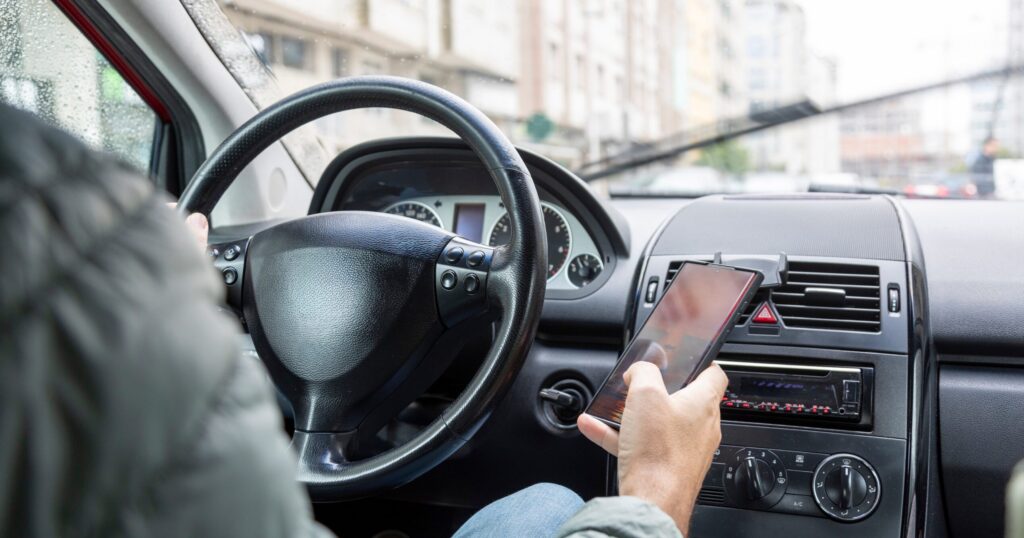
When people think about car accidents, they often picture a single mistake that leads to a collision. In reality, many crashes develop over a series of poor decisions, missed warnings, or preventable risks. A driver glances at a phone, follows another vehicle too closely, rushes through a yellow light, or continues driving despite exhaustion. Small choices can have serious consequences when thousands of pounds of metal are moving at highway speeds.
Several factors appear regularly in Washington accident investigations:
- Distraction behind the wheel: Distracted driving is still a leading cause of car crashes in Washington. Cell phone use is a huge problem, but it is not the only distraction. Drivers may engage with other passengers, fiddle with their navigation systems, eat food, or get distracted by activities happening outside their vehicle.
- Excessive speed: Faster and larger vehicles need more time and distance to stop. Traveling at higher speeds gives drivers less time to react to sudden hazards. Speed can also turn a relatively minor collision into one that causes severe injuries.
- Alcohol or drug impairment: Impaired drivers often struggle with judgment, reaction time, and vehicle control. These cases frequently involve severe to catastrophic injuries.
- Fatigue: A tired driver may experience many of the same impairments associated with alcohol use, including delayed reactions and reduced awareness.
- Intersection errors: Many crashes occur when drivers run red lights, misjudge gaps in traffic, turn left without leaving enough of a clearance, or fail to yield the right-of-way.
- Aggressive behavior: Tailgating, abrupt lane changes, and attempts to weave through traffic can increase the risk of a collision.
- Weather conditions: Rain, fog, snow, and ice are common in many parts of Washington. Poor conditions demand greater caution, but not every driver adjusts accordingly.
- Commercial vehicle errors: Delivery drivers, company vehicle operators, and truck drivers often face scheduling pressures, long hours, and other issues that can increase the risk of a crash.
- Washington Highways Present Additional Risks: Washington’s busiest highways, like I-5, I-90, and I-405, add congestion, merging traffic, and sudden slowdowns to the risk factors above.”
The circumstances that led to a collision are not always clear at first. Police reports are an important starting point, but witness statements, video footage, vehicle data and other evidence often reveal a more complete picture of what happened.
Washington Weather Creates Unique Accident Risks
Weather is a fact of life in Washington, and drivers often have to contend with conditions that can change quickly. A clear morning commute can turn into a rainy drive home, while mountain roads that appear safe at the start of a trip may become difficult to navigate just a few hours later.
Not surprisingly, weather contributes to many crashes throughout the state. Rain is especially common and can create slick road surfaces, particularly during the first stages of a storm when oil and debris rise to the surface. Visibility may also suffer, making it harder to spot traffic slowdowns, pedestrians, or roadway hazards.
Winter poses its own set of challenges. Snow and ice can cut down on traction and extend stopping distances, and mountain passes often have conditions that vary wildly from those in the valleys. Drivers who don’t slow down or leave adequate space between cars can be caught out when traffic suddenly changes.
Several weather-related conditions frequently appear in accident investigations:
- Wet roads and reduced traction
- Hydroplaning caused by standing water
- Fog and limited visibility
- Snow-covered roadways
- Black ice and freezing temperatures
- Rapidly changing mountain pass conditions
Common Injuries After a Washington Car Accident
Two people can walk away from the same accident with completely different injuries. The force of impact, vehicle size, seating position, and countless other factors can influence how a person’s body responds during a collision.
Some injuries are immediately apparent. A broken bone, deep laceration, or head injury often requires immediate medical attention. Others are less obvious.
Medical providers frequently treat accident victims for:
- Concussions and traumatic brain injuries
- Whiplash and other neck injuries
- Back injuries and herniated discs
- Spinal cord trauma
- Fractures and broken bones
- Shoulder, knee, and hip injuries
- Internal injuries and organ damage
- Burns and permanent scarring
- Emotional trauma, anxiety, and PTSD
Many accident victims feel relatively fine immediately after a crash. Once the initial shock wears off and daily life begins to return to normal, new symptoms may emerge. What seemed like a minor incident can later result in pain, mobility issues, headaches, or other problems that require medical attention.
Some injuries are particularly notorious for producing symptoms that may not surface until some time after the original injury or trauma. Head injuries, soft tissue injuries, nerve injuries, and certain spinal conditions can all lead to symptoms that begin as mild discomfort but can develop into chronic pain, recurring headaches, numbness, sleep disturbances, or other problems that can interfere with daily life.
That’s why a medical assessment is a must after a crash, even if the injuries appear minor. Early treatment can help spot problems before they escalate and create documentation connecting those injuries to the accident. Both can prove important if an insurance company later disputes the character or magnitude of a claim.
Washington’s Pure Comparative Negligence Rule
After a car accident, it’s common for drivers to point fingers at one another. The reality is that many crashes aren’t entirely one person’s fault. Washington law accounts for that through a rule known as pure comparative negligence.
Washington follows one of the country’s pure comparative negligence systems. Unlike some states that prevent recovery once a person reaches a certain percentage of fault, Washington law allows injured victims to recover compensation even if they were primarily responsible for the accident. Their recovery is simply reduced by their percentage of fault.
For example, let’s say your damages are $100,000. If you’re found to be 20 percent at fault for the crash, your recovery would be reduced by 20 percent, leaving you with $80,000.
Questions about shared fault often come up in accidents involving speeding, distracted driving, unsafe lane changes, failure to yield, and multi-vehicle collisions.
Not surprisingly, insurance companies pay close attention to these issues. The more fault they can assign to you, the less they may have to pay. That’s one reason liability disputes can become a major part of a car accident claim.
When fault is contested, evidence matters. Witness statements, traffic camera footage, vehicle data, and other records can help paint a clearer picture of what actually happened.
Who May Be Liable for a Washington Car Accident?
After a crash, most people focus on the driver who hit them. In many cases, that driver is responsible for the accident. However, the facts don’t always point to just one person.
Some collisions involve company vehicles, commercial trucks, defective vehicle parts, or roadway hazards. In those situations, more than one party may be responsible for the damages.
Depending on the circumstances, liability may fall on:
- Another driver who acted carelessly or violated traffic laws.
- An employer whose employee caused the crash while working.
- A trucking company that failed to follow safety regulations or properly supervise its drivers.
- A vehicle manufacturer if a defective component contributed to the accident.
- A government agency responsible for an unsafe road, a malfunctioning traffic signal, or other roadway defect.
- A rideshare or delivery company in certain Uber, Lyft, or delivery-driver accidents.
- Multiple parties are involved when several factors contribute to the same collision.
The answer isn’t always obvious in the days after an accident. Police reports are a good place to start, but they don’t necessarily identify everyone who may be legally liable. A closer look at the evidence can sometimes reveal additional sources of compensation that would otherwise be overlooked.
What Compensation Can You Recover After a Washington Car Accident?
If another driver caused your accident, you may be able to recover compensation for both the financial losses you can calculate and the ways your injuries have affected your life. The value of a Washington car accident claim depends on the severity of your injuries, the cost of your medical care, how the accident affects your ability to work, and whether you are expected to have lasting injuries or limitations.
The important thing is to look beyond the bills sitting in front of you today. A serious injury can require additional treatment, keep you out of work for months, reduce your future earning ability, or change what you are physically able to do. Accepting a settlement before those losses are understood can leave you responsible for costs that show up later.
Compensation in a Washington car accident claim may include:
- Medical expenses, including emergency care, hospitalization, rehabilitation, medication, and reasonably anticipated future treatment
- Lost income for time you were unable to work because of your injuries
- Reduced earning capacity if an injury limits your ability to earn income in the future
- Pain and suffering, including the physical pain and emotional effects of your injuries
- Disability and loss of enjoyment of life when an injury creates lasting limitations or prevents you from doing things you previously enjoyed
- Property damage, including the cost of repairing your vehicle or its value if it was totaled
- Other accident-related expenses and losses supported by the facts of your case
There is no reliable formula that can tell you exactly what a Washington car accident claim is worth. Two people can suffer similar injuries but experience very different financial and personal consequences. A car accident lawyer can evaluate the full effect of the crash before determining what compensation should be pursued from the responsible parties and insurers.
Washington PIP Insurance and How It Works
Washington is not a no-fault insurance state. Instead, liability generally depends on who caused the accident. Personal Injury Protection (PIP) provides optional first-party benefits that can help cover certain expenses regardless of fault.
Many drivers are surprised to learn that some accident-related expenses may be covered by their own insurance policy, regardless of who caused the crash. This coverage is known as Personal Injury Protection (PIP).
PIP is optional in Washington, although insurers are generally required to offer it when a policy is purchased. Drivers can reject the coverage in writing, which means not every policy includes PIP benefits.
When available, PIP may help pay for:
- Medical expenses
- Lost wages in certain situations
- Essential household services
- Funeral expenses in fatal accident cases
One of the main benefits of PIP is that it can provide access to coverage before a liability claim is resolved. This may help accident victims pay for treatment and other expenses while their case is ongoing. PIP benefits don’t stop an injured person from taking the at-fault driver to court for damages. But they can offer an extra source of income while the person recovers.
Why Insurance Companies May Dispute a Washington Car Accident Claim
Most people don’t deal with insurance claims very often. Insurance adjusters, on the other hand, handle them every day. That experience can create an uneven playing field, especially when someone is trying to heal from injuries while juggling paperwork, medical appointments and time away from work.
Not every claim dispute is the result of bad faith, but insurance companies often look closely at factors that could reduce what they ultimately pay. Common examples include:
- Disputing the seriousness of an injury
- Arguing that a medical condition existed before the accident
- Claiming the injured person shares some responsibility for the crash
- Pointing to delays or gaps in medical treatment
- Questioning whether certain procedures or treatments were necessary
- Making an early settlement offer before the full extent of the injuries is known
A quick settlement can be tempting, particularly when medical bills start arriving and income is interrupted. The problem is that some injuries take time to fully develop, and once a claim is resolved, additional compensation may no longer be available.
Insurance companies rely heavily on documentation. Medical records, pictures, witness statements, video, and other evidence often play a major role in how a claim is assessed. The better the evidence, the harder it is to minimize the effects of an accident.
How Dolman Law Group Builds Strong Washington Car Accident Cases
No two car accident cases are exactly alike. A rear-end collision involving minor injuries requires a different approach than a crash involving disputed liability or long-term medical treatment. That’s why Dolman Law Group begins with a thorough examination of the facts of each case rather than relying on a cookie-cutter approach. Police reports, medical records, photographs, witness statements, and other evidence can all help tell the story of what happened and who should be held accountable.
Many victims of accidents do not realize just how much evidence can disappear in the days and weeks after a crash. Witnesses become harder to find, surveillance footage can be lost, and memories naturally fade over time. Our team works to preserve important evidence early in the process, as well as to document how an injury has impacted a client’s health, work and day-to-day life.
Building a strong claim also means looking ahead. Some injuries heal quickly, while others require ongoing treatment and create challenges that last for months or years. Dolman Law Group’s Washington auto accident attorneys take the time to evaluate both the immediate and long-term consequences of an accident so that clients are not pressured into accepting less than they may need to move forward.
How Long Do You Have to File a Car Accident Lawsuit in Washington?
Deadlines matter after a car accident. In Washington, the time limit for filing most car accident lawsuits is three years from the date of the crash. That rule generally applies to claims involving personal injuries as well as vehicle damage. Under Washington’s statute of limitations (RCW 4.16.080), most personal injury lawsuits arising from motor vehicle accidents must be filed within three years. Missing this deadline can permanently prevent you from pursuing compensation.
Although three years may sound like a long time, important evidence rarely becomes easier to gather as the months pass. Witnesses move, memories become less reliable, and records that could help support a claim may no longer be available. Insurance negotiations can also take time, particularly when serious injuries are involved.
The three-year deadline does not apply in every situation. Certain cases involve exceptions, including claims involving minors, individuals who are legally incapacitated, or circumstances where an injury could not reasonably have been discovered right away. Claims against government entities may also be subject to special procedural requirements.
A missed deadline can prevent an injured person from pursuing compensation through the court system. For that reason, it is usually a good idea to learn about your legal options sooner rather than later, even if a lawsuit ultimately never becomes necessary.
Why Clients Trust Dolman Law Group
Choosing the right attorney after a serious car accident can make a significant difference in the outcome of your case. At Dolman Law Group, we combine personalized client service with the resources necessary to handle complex injury litigation.
Clients trust our firm because we offer:
- Extensive trial experience handling serious personal injury cases.
- National recognition for representing injured clients in high-profile litigation.
- Hundreds of millions of dollars recovered for injury victims nationwide.
- Access to investigators, accident reconstruction experts, medical specialists, and litigation support professionals.
- A willingness to take cases to trial when insurance companies refuse to make fair settlement offers.
While many personal injury claims resolve through negotiated settlements, insurance companies often evaluate cases differently when they know a law firm is fully prepared to present the case before a jury.
Frequently Asked Questions About Car Accident Claims in Washington State
What if the driver who hit me doesn’t have car insurance?
You may still be able to recover compensation through your own uninsured motorist coverage if your policy includes it. A review of the available insurance policies can help determine what options exist.
What if the other driver’s insurance isn’t enough to cover my damages?
Serious injuries can result in damages that exceed a driver’s policy limits. In those situations, underinsured motorist coverage may provide an additional source of compensation.
When should I call a car accident lawyer?
Call a lawyer the same day if possible. If not, you should contact a lawyer as soon as your injuries have been stabilized. This benefits your claim, especially if anyone suffered injuries, liability is disputed, or the insurance company questions your claim. Early legal representation can help preserve evidence and protect your rights.
What happens if something on my car accident police report is wrong?
If you find an error or important facts that are missing from your police report, it is important to take immediate steps to correct those errors. Get a copy of your police report as soon as it is available and immediately examine all the information to make sure it is accurate. Factual errors should be easy to correct by contacting the police department and providing documentation that supports your request for a correction. Subjective errors, such as an account of the crash, are harder to correct. Your attorney can guide you through that process.
Should I talk to the insurance adjuster about my car accident claim?
Be cautious whenever you speak with an insurance adjuster. While you should promptly notify your own insurance company of the accident, the at-fault driver’s insurer may ask questions designed to minimize your claim. Stick to the facts. Do not guess about fault, admit fault, discuss your injuries, or accept a settlement. Those are things you should discuss with your attorney first.
How are Uber and Lyft accident claims different?
Rideshare accidents often involve multiple insurance policies. The coverage available may depend on whether the driver was offline, waiting for a ride request, or actively transporting a passenger when the accident occurred.
How long will my car accident case take?
Some claims resolve in a matter of months, while others take considerably longer. Liability disputes, ongoing medical treatment, and insurance negotiations can all affect the timeline.
Do most car accident cases end up in court?
No. Many cases are resolved through settlement negotiations. However, every case should be prepared as though litigation may become necessary.
How much does it cost to hire Dolman Law Group?
Most personal injury cases cost nothing up front. They are generally handled on a contingency fee basis. That means clients generally do not pay attorneys’ fees or out-of-pocket costs during the legal process. You only pay if compensation is recovered when the case resolves.
Contact a Washington Car Accident Lawyer Today
Life doesn’t stop after a car accident. Bills still need to be paid, work responsibilities don’t disappear, and insurance companies often start asking questions before you’ve had a chance to fully recover. It’s a lot to deal with, especially when you’re also trying to focus on your health and your family.
That’s where experienced legal guidance can make a difference. At Dolman Law Group, we help people throughout Washington navigate the challenges that often follow a serious accident. We take the time to understand your situation, answer your questions, and explain your options in plain English.
If you were injured in a Washington car accident, contact Dolman Law Group today for a free legal consultation with a skilled and dedicated Washington accident and injury attorney. We’ll review your case, discuss your concerns, and help you determine the best path forward.
