

Legally Reviewed by Matthew Dolman
Matthew Dolman is the managing partner of Dolman Law Group, a nationally recognized personal injury law firm that represents accident and injury victims across the United States. Over the course of his career, Matt has helped recover more than $700 million for injured clients and has led or co-counseled on over 1,000 cases involving serious injuries, wrongful death, sexual abuse, and defective products, including against major corporations like pharmaceutical giants Johnson & Johnson, Bayer, and Pfizer, industrial manufacturers like 3M, and emerging tech platforms like Roblox, Meta, and Snap.
Matt is known for taking on large insurance companies and corporate defendants and is not afraid to take cases to trial when insurers and mega corporations are unwilling to uphold their end of the bargain. While many firms focus on quick settlements, Matt and all the lawyers at Dolman Law Group build cases with a trial in mind from day one, which often leads to stronger outcomes for his clients. Because of this, insurance companies know that Dolman Law Group means what it says, which helps take bluffing off the table.
Matt has been featured in major national publications, including the Los Angeles Times, Washington Post, Forbes, WIRED, and People Magazine, and is widely respected for his results-driven approach to personal injury law.
This page has been reviewed to ensure accuracy and clarity based on current personal injury law and the types of injuries commonly seen after car accidents.

Car accidents are one of the primary causes of upper and middle back pain. A back injury caused by a car accident is sometimes visible and sometimes not. It may not appear for days or even weeks after the collision. This delayed pain is common after a car crash or car wreck due to the body’s adrenaline response, which can initially mask symptoms of car accident injuries.
You should see a doctor as quickly as possible for a precise diagnosis, especially if you’re experiencing discomfort and difficulties moving. Prompt medical care is essential to rule out serious auto accident injuries and prevent long-term complications. Upper back pain can worsen if left untreated. It could be a sign of a severe injury or complication.
Upper and middle back pain is frequently associated with rear-end collisions since the head is jolted back and forth, causing neck and upper back injury. The violent motion of a car accident can cause upper back injuries such as muscle strains, ligament tears, and other soft tissue injuries, which are common injuries after car accidents. It may also happen due to the driver swerving off the path or slamming on the brakes to prevent an impact.
Depending on the cause, many bodily systems around the spine’s vertebrae can be harmed. These could include tendons, muscles, discs, ligaments, and nerves. The cervical spine (neck region) and thoracic spine (upper back) are particularly vulnerable in car accident injuries. The following are some of the most prevalent injuries that cause back discomfort in people involved in car accidents.
Introduction to Back Pain
Back pain is one of the most common health complaints, and it often arises after a car accident due to the sudden force exerted on the body. The impact of a collision can strain or injure the spine, muscles, and soft tissues, resulting in upper back pain, neck pain, and discomfort that may interfere with daily activities.
Recognizing the signs of back pain early is crucial, as prompt medical treatment can prevent minor injuries from developing into more serious conditions.
If you experience back pain after a car accident, consulting a healthcare provider is essential for an accurate diagnosis and effective care. Additionally, a personal injury lawyer can help you understand your rights and guide you through the process of filing a personal injury claim, ensuring you receive the compensation you deserve for your injuries and related expenses.
Common Upper and Middle Back Injuries from Car Accidents
Injuries that commonly cause upper back pain after a car accident include fractured vertebrae, herniated discs, dislocated ribs, rotator cuff tears, shoulder fractures, and muscle strains and sprains.
Fractured Vertebrae in the Upper to Middle Back
Fractured vertebrae in the upper and middle back are serious injuries that can occur when the force of a car accident places extreme pressure on the spine. These fractures can range from small cracks to severe breaks that compromise the stability of the entire spinal column.
Symptoms often include intense, localized pain, reduced mobility, and in more severe cases, nerve damage that can lead to numbness, tingling, or even partial paralysis. Because the thoracic spine plays a critical role in protecting the spinal cord, these injuries can have long-term and sometimes permanent consequences.
Herniated Discs in the Upper to Middle Back
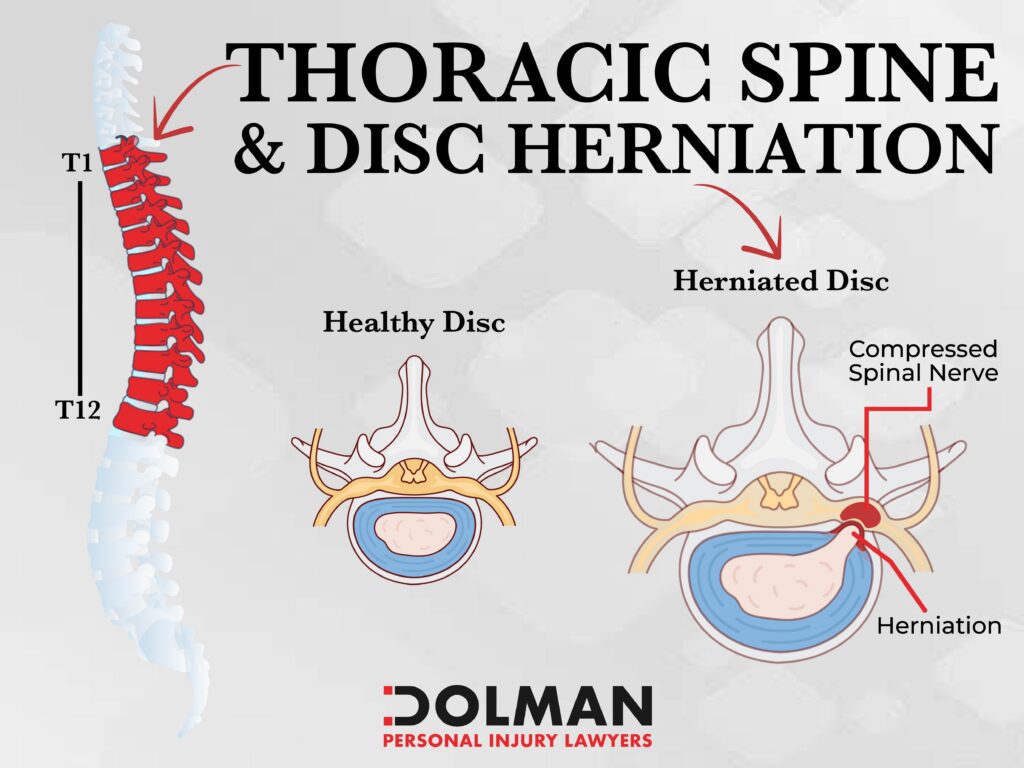
Herniated discs in the middle and upper back, known as the thoracic spine, are a common injury that occurs during a car accident. A herniated disc in this part of the spine can lead to everything from discomfort to life-altering pain.
This includes mild to severe pain, numbness, lack of strength in the back, arms, and legs, anything from tingling to shooting pain, and dozens of other symptoms. This wide array of outcomes is due to the compression of nerves in the spine, which are so numerous that the resulting pain can be almost anything.
Dislocated or Broken Ribs in the Upper Back Area
Dislocated or broken ribs are another common injury tied to the force of impact in a car accident, especially when the upper body is thrown against a seatbelt or steering wheel. These injuries can cause sharp, stabbing pain that worsens with movement, breathing, or even coughing. In more serious cases, displaced ribs can irritate or damage nearby organs and tissues. What might initially feel like simple soreness can quickly become debilitating, making even basic movements difficult and painful.
Rotator Cuff Tears from Accident Trauma
Rotator cuff tears often happen during a car accident when the shoulder absorbs sudden force or is twisted unnaturally. This group of muscles and tendons is essential for shoulder movement, so even a partial tear can lead to significant pain and loss of function. Symptoms typically include weakness, limited range of motion, and persistent discomfort that may worsen over time. In more severe cases, individuals may struggle to lift their arm at all, making everyday tasks frustrating or even impossible.
Shoulder Fractures After a Car Accident
Shoulder fractures can occur when the body is jolted forward or sideways during a crash, causing direct impact to the shoulder joint or surrounding bones. These fractures may involve the clavicle, scapula, or upper arm bone, and can result in immediate, intense pain along with swelling and visible deformity. Depending on the severity, a fractured shoulder can significantly limit mobility and require extensive recovery time, including immobilization or even surgery. Left untreated, these injuries can lead to long-term stiffness and reduced function.
Muscle Strains and Sprains in the Upper and Middle Back
Muscle strains and ligament sprains are among the most common upper and middle back injuries after a car accident, often caused by the sudden whipping motion of the body on impact. While they may sound minor, these injuries can lead to persistent pain, stiffness, and reduced flexibility that interferes with daily life. Symptoms can range from mild soreness to sharp, ongoing discomfort that worsens with movement. In some cases, what starts as a strain can develop into chronic pain if not properly treated and given time to heal.
Understanding Injuries to the Thoracic Spine
The thoracic spine, commonly referred to as the upper back, plays a vital role in supporting the body and protecting internal organs. Composed of 12 vertebrae connected to the ribs, the thoracic spine is less flexible than the cervical (neck) or lumbar (lower back) regions, making it particularly vulnerable to injury during a car accident.
The force of a collision can cause facet joint injuries, herniated discs, or even spinal stenosis, all of which can lead to significant upper back pain and require immediate medical attention. Injuries to the facet joint can result in stiffness and reduced mobility, while damage to the thoracic spine may also affect the lumbar spine, compounding back pain and discomfort.
Early diagnosis and treatment are essential to prevent complications and promote recovery.
Strains and Sprains
Lumbar spine strains and sprains are common injuries and a form of soft tissue damage following a car collision. The muscles, tendons, and ligaments in the lower back might overstretch or rupture due to the force of contact. The American Association of Neurological Surgeons states that discomfort, tightness, and spasms are common side effects of strains and sprains. Tight muscles and soft tissue damage can contribute to ongoing pain and limited mobility. Facet joint injuries can also affect nerves and muscles, causing pain, tenderness, and muscle spasms.
Fractures
Compression fractures, a type of spinal fracture, of the lower and middle back are common injuries after car accidents. A seat belt keeps the lower half of the body in place while the top half is abruptly flung forward, resulting in fractured vertebrae. Spinal fractures involve damage or breaks in the vertebral bones and may impact the spinal canal, potentially leading to neurological symptoms and pain. The discomfort can be extremely unbearable.
Whiplash
Low-speed rear-end collisions are a common cause of whiplash, which is one of the most common car accident injuries. The force of a vehicle crash causes the head to rock back and forth, resulting in the sudden extension and flexion of the neck. This violent motion can stretch or tear the neck’s muscles and tendons, and may cause upper back pain. Symptoms of whiplash and related upper back pain may not appear immediately after the incident, as adrenaline and shock can initially mask the pain.
You can usually manage mild cases of whiplash at home with over-the-counter pain relievers and exercise, and they will improve independently. Chronic neck pain may develop in more acute cases, necessitating more thorough medical attention.
Injuries to the Spinal Cord
Accidents involving motor vehicle accidents are a leading cause of traumatic injury and serious injury to the spinal cord. Mayo Clinic affirms that victims with “incomplete” spinal cord injuries may retain motor capabilities, although determining the extent of the damage might take weeks.
Spinal cord injuries are a type of serious injury that require immediate medical attention. Spinal cord injury can leave victims disabled for the rest of their life. It can result in loss of sensation and function below the injury spot. Apart from total or partial paralysis, spinal cord injuries can result in persistent pain, blood clots, infections, and other serious complications.
Back Injury and Spinal Disc
A back injury from a car accident can cause the spinal disc to shift or herniate, pressing against nearby nerves and resulting in pain, numbness, or tingling sensations. The spinal disc acts as a cushion between the vertebrae, absorbing shock and allowing for smooth movement. When a spinal disc is damaged, it can cause significant pain and limit mobility, especially in severe cases where the disc herniation is pronounced. Medical treatment options such as physical therapy and pain medication can help manage symptoms and support healing. In some situations, especially when conservative treatments are ineffective, surgery may be necessary to repair or replace the damaged spinal disc. Prompt attention to these injuries is crucial to prevent long-term nerve damage and restore function.
Early Symptoms of Upper and Middle Back Injury
After a car accident, you may feel sore and achy for a few days, which is entirely normal. However, keep an eye out for any unusual pain or sensations. Delayed pain is common after car accidents—symptoms of upper back pain may not appear immediately and can develop gradually or even suddenly weeks later due to underlying injuries. Following a car accident, be on the lookout for the following signs and symptoms. Any or all of the following symptoms could indicate a significant back injury requiring medical attention.
- The ability to move normally is lost
- Pain that worsens when you lift, bend, or twist your body
- Numbness, tingling, and weakness on one side of the low back, buttocks, leg, and foot
Seeking prompt medical treatment for upper back pain after a car accident is essential for effective pain relief and to prevent untreated injuries from worsening into chronic pain.
Many people overlook the signs and symptoms of a back injury following a car accident, assuming that the pain would go away on its own within a few days. However, even a slight but acute back injury can result in persistent discomfort and degenerative changes in the spine.
Causes of Delayed Back Pain
It’s not uncommon for back pain to develop hours or even days after a car accident. The body’s natural response to trauma, including the release of adrenaline, can temporarily mask pain and other symptoms. As adrenaline levels decrease, inflammation and discomfort may become more noticeable, leading to delayed back pain. Soft tissue injuries, such as muscle strains and ligament sprains, are frequent culprits behind these delayed symptoms. These hidden injuries can worsen if left untreated, so it’s important to seek medical attention as soon as any pain or unusual sensations arise after a car accident. Early diagnosis and intervention can help address soft tissue injuries before they lead to chronic pain or more serious complications.
What Should You Do If You Have Upper and Middle Back Pain?
Keep an eye out for delayed indications of an upper and middle back injury after a vehicle accident. Auto accident injuries often have delayed symptoms, and prompt medical care is crucial to rule out serious injuries and facilitate recovery. During a traumatic occurrence, your body produces a large amount of adrenaline, which can conceal typical pain signals just after a crash. Even if you feel good right after the accident, consult a doctor if you experience discomfort or symptoms over the next few days, weeks, or months.
Your doctor might recommend physical therapy, drugs, a corticosteroid injection, or the use of cold packs as part of your treatment strategy. Common treatment options for upper back pain after a car accident include physical therapy, chiropractic adjustments, pain management strategies, and, in severe cases, surgical interventions. Chiropractic care can be an effective treatment for upper back pain, providing pain relief and a holistic approach through spinal adjustments and other therapeutic techniques. Many back injuries heal in a few weeks to months with adequate care. Otherwise, you might need surgery if you’re still in pain and have limited mobility after many weeks of medicine and physical therapy.
After you’ve seen a doctor, you might wish to speak with a personal injury lawyer who has handled cases similar to yours. If you suffer upper back pain after a car accident, you may be entitled to file a lawsuit against the at-fault driver’s insurance company to recover compensation for your injuries, including pain and suffering. In Michigan, to recover No-Fault insurance benefits for medical bills and lost wages after a car accident, you must file an application with the responsible auto insurance company within one year of the crash. To successfully claim compensation for upper back pain from a car accident, you must prove that your injuries constitute a ‘serious impairment of body function’ under Michigan’s auto accident threshold law. Back injury claims are frequently complicated. The opposing party’s insurance company could prove difficult to work with.
Long-Term Consequences of Back Injury
If back injuries sustained in a car accident are not treated effectively, they can result in chronic pain, persistent pain, and significant pain that disrupts daily life. Long-term consequences may include conditions such as spinal stenosis, degenerative disc disease, and facet joint syndrome, all of which can cause burning pain, tingling sensations, and numbness in the affected area. These issues can make even simple movements difficult and may lead to ongoing discomfort or disability. Seeking medical attention promptly after a car accident is essential for preventing these long-term effects and supporting injury recovery. A comprehensive treatment plan—often involving physical therapy, pain medication, and chiropractic care—can help reduce inflammation, restore mobility, and promote healing. Addressing back injuries early increases the likelihood of a full recovery and helps prevent lingering pain from becoming a permanent part of your life.
Don’t Pay for Someone Else’s Mistake. Call Our Team Now!
The Dolman Law Group’s auto accident injury attorneys represent clients with auto accident injuries and car accident injuries resulting from motor vehicle accidents. We can ensure you receive all the compensation the law provides, especially when insurance companies attempt to minimize or deny coverage for injuries sustained in car accidents. If you have been hurt in an automobile accident, contact our law firm for a free consultation.
We’re happy to answer any questions, explain what goes into filing a personal injury claim, and go through your legal alternatives with you. Back and neck injuries are not something you should ignore.
